
By Staffing Boutique, Inc.
When an educator leaves a school, the immediate loss is emotional and instructional. A familiar face disappears from the hallway, classroom routines fracture, and remaining staff step up to cover the slack.
However, there is another critical side to teacher churn that rarely receives top billing in annual budget meetings: the direct financial drain.
According to research published by the Learning Policy Institute (LPI), teacher turnover isn't just an HR headache—it is a major financial drain quietly consuming operating budgets that could otherwise fund student programs, competitive salaries, or facility upgrades.
As school leaders head into the new academic year facing persistent national hiring shortages, understanding the true cost of turnover is the first step toward building a sustainable recruitment and retention strategy.
1. The True Cost per Departure: Up to $20,000+
While many administrators calculate hiring costs simply by looking at job board fees, the Learning Policy Institute highlights that the comprehensive cost of replacing a single teacher ranges from $9,000 in smaller rural districts to upwards of $20,000 in large urban charter networks and public school systems.
Where does all that capital actually go?
- Separation Costs: Administrative processing, exit interviews, and payout of unused leave time.
- Recruitment & Advertising: Job postings, recruitment platform subscriptions, career fair fees, and marketing collateral.
- Administrative Screening: Dozens of hours spent by Principals, Deans, and HR teams screening resumes, conducting interviews, and checking credentials instead of focusing on school leadership.
- Onboarding & Professional Development: Training new hires on school culture, curriculum mapping, software platforms, and classroom management systems.
- Interim Coverage: Subbing costs, stipend payments for internal staff covering extra prep periods, or lost productivity during vacancy windows.
For an independent charter school or single-site network losing 5 to 10 educators annually, that translates to a $100,000 to $200,000 annual budget drain—money spent simply staying in place rather than moving forward.
2. The Invisible Cost: Academic & Organizational Drag
The LPI research emphasizes that the financial price tag is only half the story. The ripple effects of frequent churn impact school operations in two major ways:
Depressed Student Achievement
Turnover disproportionately affects high-need schools and specialized departments like Special Education, STEM, and Bilingual/ELL. When experienced educators leave, they take institution-specific knowledge and pedagogical expertise with them. Research consistently shows that high teacher turnover directly correlates with lower student math and reading scores across the entire building—even for students whose individual teachers didn't leave.
The "Burnout Loop" Among Retained Staff
When a teaching line remains open into the fall, remaining staff members absorb the burden. Covering prep periods, combining classes, or mentoring an influx of inexperienced replacements, leads to institutional exhaustion. This extra strain often triggers secondary resignations mid-year, creating a continuous cycle of turnover.
3. How High-Performing Schools Protect Their Budget & Culture
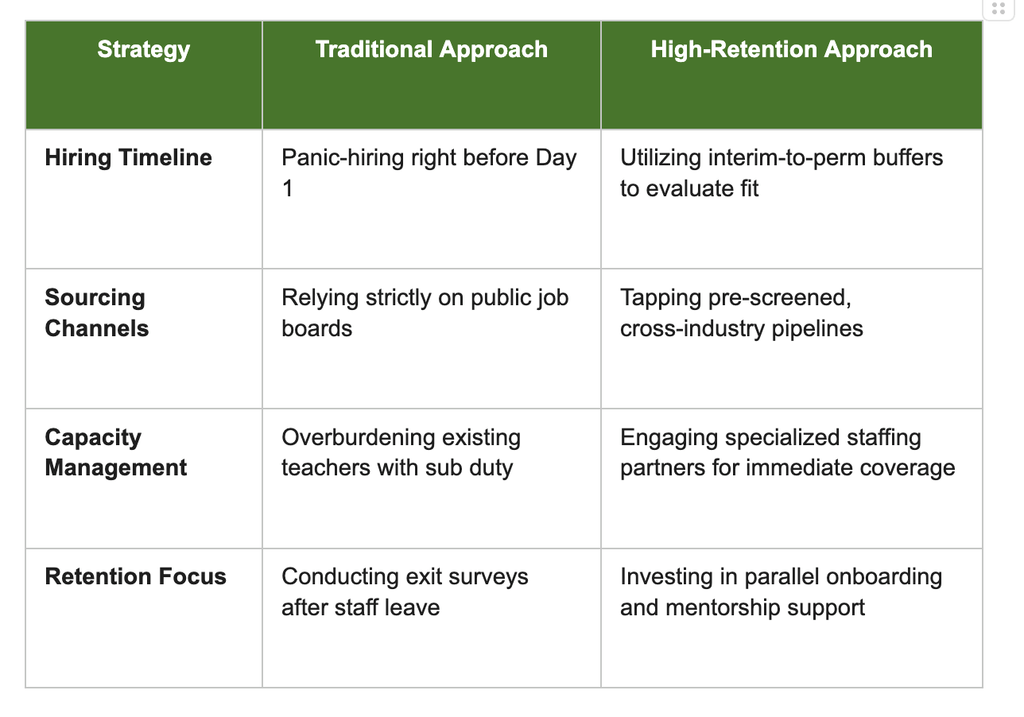
Understanding the financial cost of turnover allows school leaders to shift from reactive "cramming" to proactive strategy. Here is how leading charter and private school networks protect their budgets:
The "Burnout Loop" Among Retained Staff
Instead of locking into high-risk permanent contracts under time pressure—which often leads to mid-year terminations and repeated recruitment costs—smart schools leverage interim and long-term substitute solutions.
By bringing in vetted, qualified professionals on a flexible basis, schools can:
- Ensure full classroom compliance and stability on Day 1.
- Evaluate classroom management and cultural alignment in real time.
- Protect existing staff from burnout while conducting a deliberate search for permanent lines.
The Bottom Line
Every open seat on your org chart represents both an educational gap and a financial investment. By treating talent acquisition as a strategic year-round priority rather than an August emergency, school leaders can protect their operating budgets, stabilize their culture, and keep their focus where it belongs: on student success.
Need support closing key vacancies without compromising on quality?
At Staffing Boutique Inc, charter and nonprofit education staffing is all we do. Whether you need immediate interim coverage or a strategic partner to build your long-term talent pipeline across NY & NJ, we’re here to help. Connect with our team today!